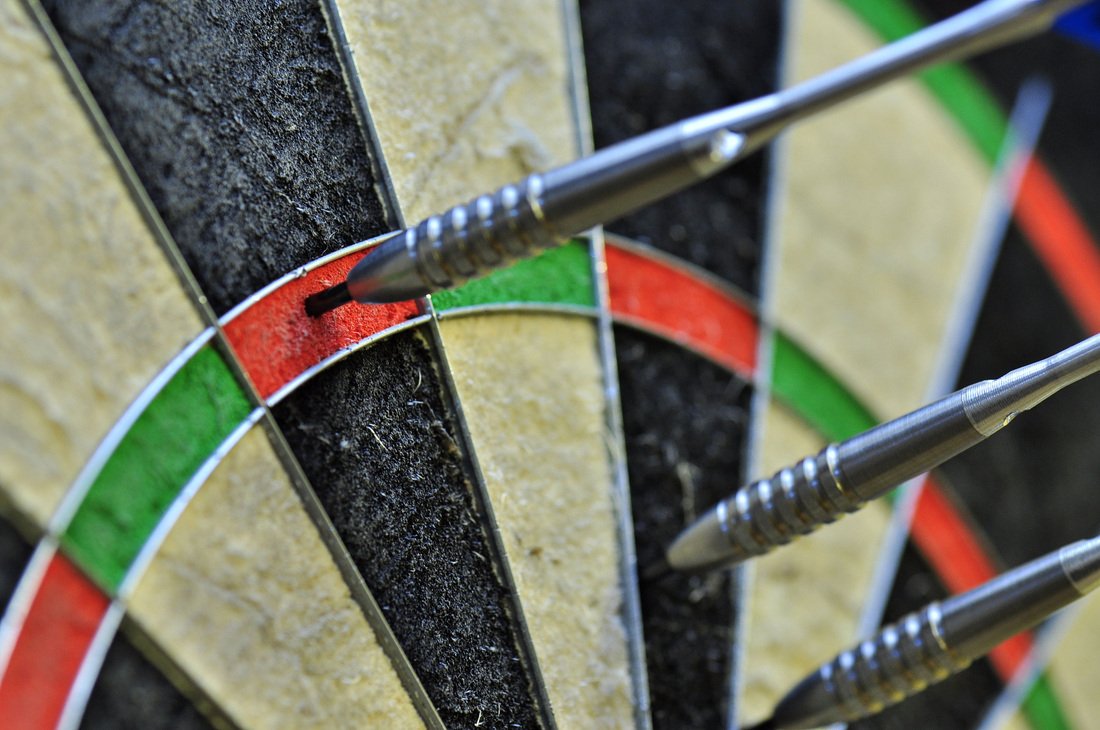
Most people buy their first darts by guessing. They pick a set that looks good, find it feels wrong after a week, and blame their throw.
Short answer: start at 22 to 24 grams, find a grip that feels secure without squeezing, and buy brass or nickel-silver until you know what you like.
A good first set comes down to two things: the weight, and the grip, which is how the barrel feels in your fingers. Neither is complicated once you know the terms.
This guide explains each one in plain terms, and finishes with the few accessories worth buying first.
What dart weight should a beginner use?
Dart weight is measured in grams, and it is the weight of one dart, not the set.
Most steel-tip darts weigh between 20 and 26 grams, and 22 to 24 grams is a common place to start; Harrows, one of the brands we carry, suggests exactly that for a first set. Some players get on better with something heavier, and there is no single right answer, which is why we keep a board set up in the store. Throw a few weights and you will know. A heavier dart tends to feel steadier, and a lighter dart is easier to throw with a quick, flicking release.
To test a weight, hold the dart in your throwing hand and throw a few rounds. If the dart drops short or feels like you are pushing it, try a little heavier. If it flies high or feels hard to control, try lighter.
Brass, nickel-silver or tungsten?
- Brass. The least expensive option. Brass is lighter for its size, so brass barrels are usually thicker.
- Nickel-silver. A harder-wearing alloy that costs more than brass.
- Tungsten. A very dense metal, so a tungsten barrel is slimmer at the same weight. It is the most expensive, and it is what most serious players use.
A brass set is a perfectly good way to learn. Tungsten can wait until you know what you like.
Which grip and barrel shape suits you?
Grip is personal. Barrels come straight, tapered or torpedo-shaped, and with different surface finishes, from smooth to deeply ringed or knurled.
A smoother barrel lets the dart leave your fingers freely. A more textured barrel gives you more to hold on to. Pick a few, hold them the way you would to throw, and notice which one feels secure without squeezing.
Thinner barrels suit a lighter hold, and thicker barrels suit players who like to grip firmly.
Shafts and flights
The shaft joins the barrel to the flight. Shafts come in short, medium and long lengths and in plastic, nylon and metal. A longer shaft tends to make the dart sit more nose-up in flight, and a shorter one makes it sit flatter.
The flight is the fin at the back. It comes in a few shapes, including standard and slim. Flights are the part you replace most often, so it is worth having spares.
Changing the shaft length or the flight shape is a cheap way to adjust how a dart flies without buying a new set. Change one thing at a time so you can tell what made the difference.
Accessories worth buying first
- A case or wallet to keep the set together.
- A spare set of flights and shafts.
- Flight protectors, which protect your flights when your next dart hits them.
A sharpener matters only once the points start to dull. Everything else can wait until you know how often you play.
Compare darts in person at Twilight
The easiest way to choose is to throw a few sets. We have a board set up in the store, so you can try different weights and grips before you buy, and staff will help you narrow it down.
See what we carry on our darts page, or call (250) 384-2545 to ask about a particular set. We are at 3340 Oak St, Victoria. If you play in a local league, you save 10% on darts and supplies; our guide to dart leagues in Victoria covers how to join one. If we do not have a set on the wall, we can order it in for you.